TABLE OF CONTENTS
- 1. Introduction
- 2. Web-based Remote Control (Default)
- 3. Executable Remote Control
- 4. Troubleshooting
- 5. General Prerequisites
1. Introduction
Remote Control allows you to access computers directly from the five(9)s Console. You can launch Remote Control from:
1. The Home screen by clicking the Remote Control button. 
2. Central Search by selecting Remote Control from the hover menu of a computer search result.
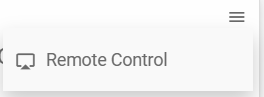
The five(9)s Console supports two Remote Control Modes:
1. Web-based Remote Control, which opens in a new browser tab. (Default)
2. Executable Remote Control using the RCViewer application running on the user's computer.
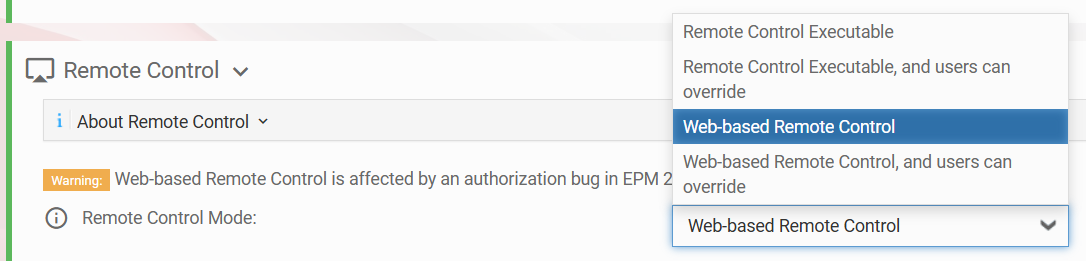
The Remote Control Mode can be configured on the Admin page under General Settings.
The configuration consists of the selected Remote Control Mode and whether User Override is enabled. The latter determines whether five(9)s Console users can select a different Remote Control Mode from the user tile in the top right of the navigation menu to override the global configuration.
2. Web-based Remote Control (Default)
The web-based mode opens Remote Control in a new browser tab. It requires accessing the Console via HTTPS using a fully qualified domain name (FQDN). Additionally, users must have the "Basic web console" permission in the EPM to use web-based remote control.
This mode always uses the user's own authorization.
Certificate Requirement

When using this browser-based WS Remote Control (https://<coreservername>/remotecontrol), a certificate with a trusted root chain is required.

By default, EPM installs a self-signed certificate.

Note that many EPM deployments use the default self-signed certificate and do not have a trusted root chain certificate installed on the core server.
Authorization Bug in EPM 2024 SU

Web-based Remote Control is affected by an authorization bug in EPM 2024 SU3. See this article for a workaround.
This mode uses the RCViewer executable on the user's computer.
Otherwise, it uses the authorization of the Console service account.
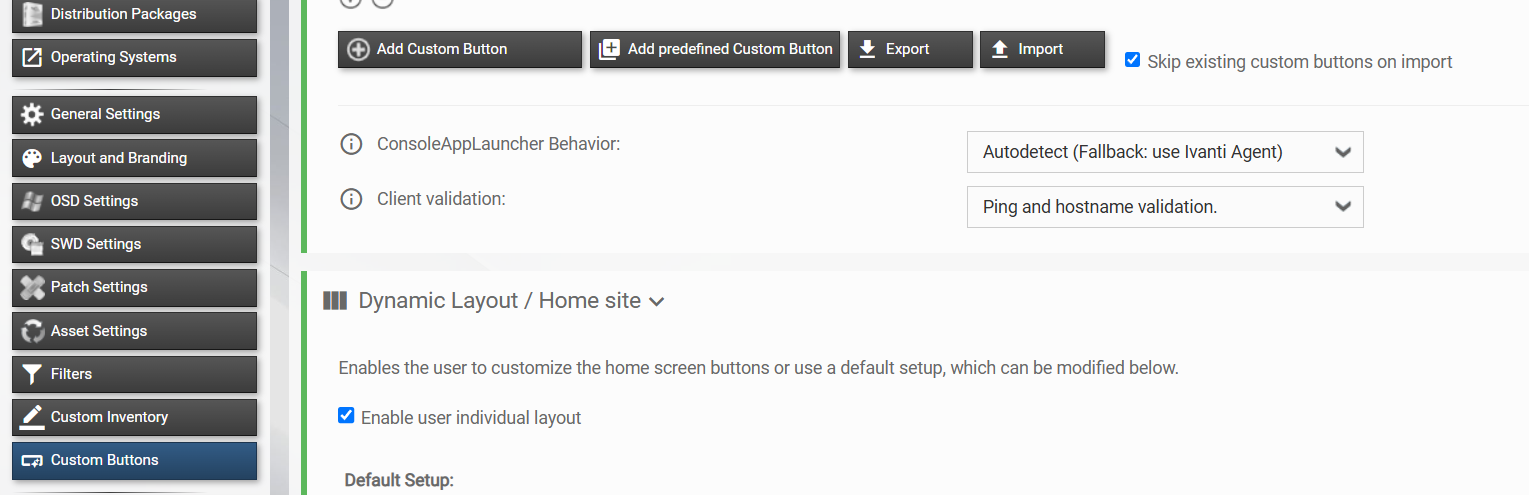
This mode launches RCViewer.exe on the user's computer. This is either done using the Ivanti Agent, or using the five(9)s Console App Launcher. You can set up the ConsoleAppLauncher behavior in the Custom Button section on the admin page.
3.1. Switching Authentication to the Console User Using ASP.NET Impersonation
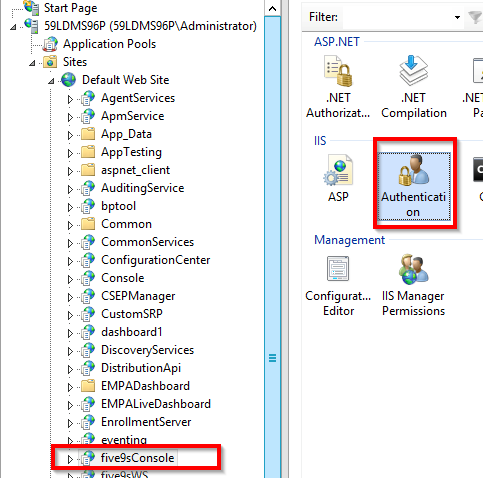
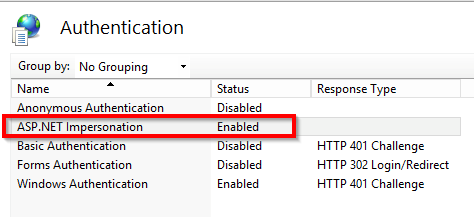
The five(9)s Console uses the service account to run RC sessions by default. If impersonation is not configured, the service account name will appear in the Remote Control authorization dialog instead of the logged-in user. To enable impersonation and authenticate as the console user instead, open Internet Information Services (IIS Manager) on the core server and navigate to: Server → Sites → Default Web Site → five9sConsole → Authentication.Then enable ASP.NET Impersonation.
3.2. RCViewer.exe Startup Location
C:\inetpub\wwwroot\five9sWS\settings.config and set the following key to True:<add key="RemoteControlUseLocalRcViewer" value="True" />
4. Troubleshooting
- If a connection cannot be established, see the Controller.log for further details.
5. General Prerequisites
- at least EPM Version 2019.1 SU1 is installed
- TCP port 4343 must be open on the target machine
- the target computer must be reachable by both the core server and the device running the five(9)s Console.
- the user needs remote control rights in the Ivanti Management Console
For more information about Ivanti's Remote Control technology (RC WS), see the
Disclaimer
03
Was this article helpful?
That’s Great!
Thank you for your feedback
Sorry! We couldn't be helpful
Thank you for your feedback
Feedback sent
We appreciate your effort and will try to fix the article